
logo_3_1

Pages

malta country of half neglected

As I sat freezing at a café in Malta, I wondered if I had made the right decision to visit.

The most naturally beautiful countries in the world

You’d be hard-pressed to find a country that doesn’t offer any natural assets, but some are more naturally gifted than others.

14 major travel scams to avoid

On my first big non-tour trip, I got scammed twice on the same day

2017: THE YEAR YOU MAKE TRAVEL HAPPEN

One of the most common New Year’s resolutions people make is to travel more. It’s right up there with eating better and going to the gym more

BEST TRAVELING WEBSITES THAT YOU SHOULD KNOW

Technology's effects on the travel industry are widespread, with innovation

Monday, 8 May 2017

WHERE TO FIND THE BEST TRAVEL DEALS

Finding travel deals is a matter of timing.
A lot of people think travel is just plain expensive, but in reality there are incredible deals happening all the time. They usually don’t last too long, and you have to act quickly. That can sometimes be a problem when a deal requires jumping on a plane tomorrow (how many people can do that?), but in fact most deals are for months in the future, giving you ample time to plan your schedule.
Often I will book a flight and then figure out my plans. Since you can cancel a flight within 24 hours without incurring a fee, I lock in the deal and then figure out if I can make it work. Sometimes I can (like the $1,200 business-class flight from LA to Stockholm round-trip); sometimes I can’t (like the $400 New Zealand flights I had to cancel).
I am always looking out for deals. Today, I want to give you a peek into where I go for deals, tips, and expert advice. After all, these are people who focus solely on this one aspect of travel, so why not use them? I can’t be everywhere and I can’t know everything, so I rely on the specialists. If travel were a hospital, I would be your general practitioner and these people below are the specialists I would consult with!

Flight deals
cabin seats on an airplane
When it comes to flights, I use three websites:
I’m subscribed to all of their newsletters so I don’t miss any flight deals. Often you’ll find the same deal on all three sites, but getting all three in my inbox each day ensures I won’t miss anything in case one website doesn’t pick up the deal.
On Twitter, I am also subscribed to Airfarewatchdog (great general deals) and YVR Deals (Vancouver Airport deals. It’s a big airport hub!). You can subscribe to them via their website too, but they usually send out so many emails that Twitter is easier!

Airline News

amazing view from a plane
When it comes to finding the latest in airline and frequent flier news, I turn to these sites, which give me the latest on the changes in the industry and loyalty programs, and any travel hacking news I can use:
(For family travel, I visit Mommy Points. For Australia/NZ travel hacking, I consult Points Hack. For Canada, I use Canadian Kilometers and for the UK, Head for Points.)
As a very, very, very avid travel hacker, and while I have my own special tricks and tips, when you’re overseas a lot, it’s hard to stay up to date on your own so I use these three sites to keep me in the loop.

Cruises
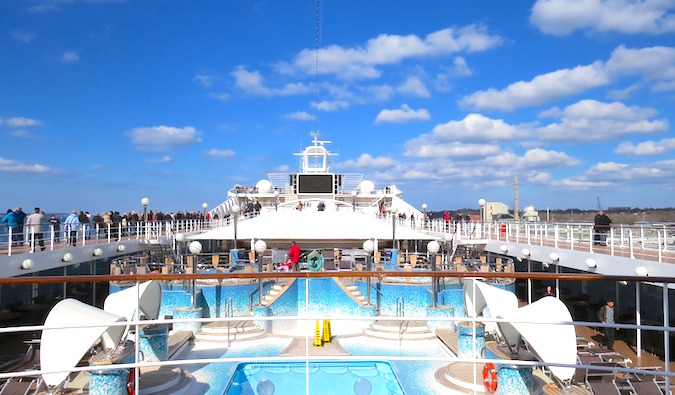
view of a cruise ship deck
In my mind, there is only one cruise deal website worth following: CruiseSheet. This site consistently has some of the lowest rates out there, and their interface is beautiful. If I don’t find anything on CruiseSheet or want to double-check a price, I go to the second-best website, vacationstogo.com.

Hotels

bed, desk, and couch in a hotel room
Hotels deals are pretty hard to find and often so limited that they don’t apply to a lot of people. Plus, as a hostel and Airbnb lover (if you’re new to Airbnb, get $35 off your first stay), I frequently just use points for hotel rooms (they’re damn expensive!). While lot of the travel hacking websites list hotel sales for large brands like Hilton and SPG, I also subscribe to the following:
Getting their emails keeps me up to date on city sales. Often, I look up the rates on their websites and then go over to the hotel’s website to book directly, as there is usually a lower rate — and I can then get points too.

Tours
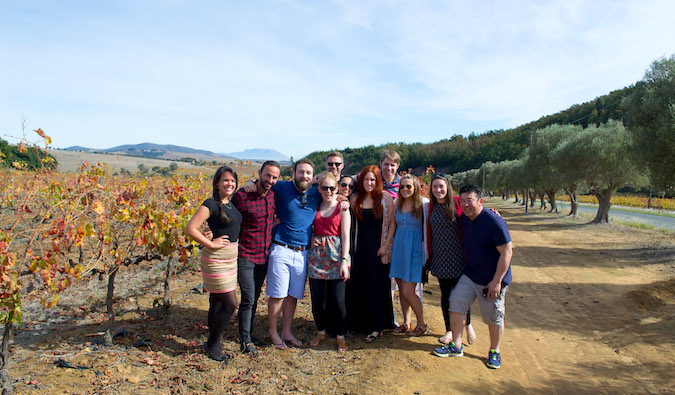
tour group posing for a photo while traveling
For tours and excursions, I keep an eye on the following companies by subscribing to their emails too:
These companies have very good last-minute deals, and if the price is right, I’ll jump on them!

The One Company I Never Use..

TripAdvisor! Though TripAdvisor isn’t a “deal website,” I want to mention it because a lot of people use it in their planning. This is one of the worst travel websites out there and I never, ever, ever use it in my research to or to look for awesome budget accommodation. While I am not against user-generated reviews, the TripAdvisor system is easily gamed and often inaccurate. The site is widely known to delete negative review; hotel owners post fake reviews; and users get demanding of owners and often say “if you don’t do this, I’ll post a negative review.” It’s an open secret in the industry that the review system is a joke. This is one website I would stay away from. Sometimes there is not wisdom in the crowds. In my professional opinion, stay clear of this website when planning your trip.
****
So while I think my site is amazing for your on-the-ground tips, tricks, and advice needs, for deals to get you to where you want to go, use the sites above. They’re what I use, and they’ve never steered me wrong!

Editor’s Note: 
I wrote a comment down below about Trip Advisor but here it is so you don’t miss it:
“There is a lot of TripAdvisor love out there! I get it. We’re all honest brokers. No one thinks of themselves as dishonest and I have no doubt that you all write honest reviews. I have no doubt many of you have had good luck with the site and found some hidden gems too.
But that’s one experience of many and, if there’s anything I’ve learned writing about travel for eight years, it is that your one experience is not always the norm.
TripAdvisor is an easily gamed service that is often mocked and laughed at by people within the industry. I can’t tell you the countless stories I’ve heard and data I’ve seen about bots, fake reviews and listings, removed reviews, and much more.
TA is a great service in theory. In practice, it’s very hit or miss and too much of a minefield. It’s not reliable tool when taken as a whole.
One person’s paradise is another person’s hell hole. In this age of user reviews, we all like to think of ourselves as experts but, in reality, the masses are a really poor judge of quality because we like the experience and frame of reference to really give a fair and unbiased opinion. The South Park episode on Yelpers really nails it on the head. As they say, everyone’s a critic!
Take it from someone in the industry, TA is a site to be avoided when choosing a place to stay or activity to do.
Use it but know that most people within the industry think it’s a hilarious joke. And if all the professionals don’t like it, maybe there is some credence to their opinion!”
I’ll also add this rhetorical question: If you take the reviews with a grain of salt, why spend time on the review site in the first place!?

HOW TO TRAVEL HACK IN AUSTRALIA AND NEW ZEALAND

One of the advantages of being a traveler from North America is that we have so many ways to travel hack. As you know, I’m a big, big fan of travel hacking (the art of collecting points and miles for free travel). It is way helps keep me in free flights, hotels, and other travel expenses. I earn over one million points a year and save many of thousands of dollars in travel expenses!
But, while North Americans have more travel hacking options than others, it’s not limited to just this reason. Today, I’m interviewing Keith Mason from PointHacks AU. Keith is the premier expert on travel hacking in Australia and New Zealand. In this interview, he shares his tips on how to collect points in miles in the lands down under!
Nomadic Matt: Tell us about yourself. How did you get started in travel hacking? 
Keith Mason: I’m originally from the UK<, but now I live in Sydney. Around five years ago, when my first child was born, I wanted to visit family back in Europe and figured that there had to be a way to ensure I didn’t end up traveling in economy the whole way.
I researched the hell out of this one trip and ended up using points to get the three of us into premium economy or business class for a round-the-world itinerary, without paying more than we would have for economy.
In the process, I realized that a lot of the information out there for someone in Australia wanting to learn more about earning and using points was either buried in forums or more relevant to overseas travelers.
My day job was making and managing websites, so starting Point Hacks was a logical next step — and now it’s my full-time gig, which is astounding!
There are some great news sites out there, locally and globally, covering the latest routes, airline news, and speculation — so we don’t try to do that. Instead, we’ve created a vast amount of frequent flyer and rewards program guides to earning and using the key currencies for us (Qantas Points, Velocity Points, Asia Miles, KrisFlyer Miles). And while we have a focus on Australia and New Zealand, many of our guides will be relevant for folks outside Australia too.
In the U.S., we have a ton of travel hacking options. What’s the industry like in Australia and New Zealand? 
I guess there are two ways to look that question: what are the opportunities when it comes to earning and using points effectively, and what’s the information on offer to help you do so like?
In terms of the opportunities, there are heaps. It’s a mature market. Qantas has half as many frequent flyer members as the total population of the country (how many of those are active, I don’t know!), a very advanced and profitable frequent flyer program, and a great and generally well-loved and well-known brand.
They have also done deals with almost every bank out there, so there a vast number of Qantas-branded credit cards. The competition between banks and retailers is generally good, so while there are only two local airlines and frequent flyer programs, consumers have a number of options to earn points.
On the redemption side, Qantas and Velocity are obviously the key players, and for the most part, burning points comes with a lot of carrier-imposed fees and surcharges. Using points for an economy flight to the US, for example, could add $500–700 in fees on what would otherwise be $1,200 cash fare.
That’s a common complaint, but it’s the first thing you realize and hopefully take into account when playing the points game here. It means it’s even more important to keep saving your points for premium cabins to get the most value from them — redeeming points for economy travel with either program is rarely great value.
There are a few outliers and hidden options to minimize fees, and this is one of the things we try to highlight on Point Hacks, when we can. For example, by using Qantas Points on American Airlines–operated flights to the US, taxes and fees are virtually nothing. Same applies for using Qantas Points on Fiji Airways to the US too.
That said, every Australian willing to look away from a Qantas-linked card has a heap of access to overseas frequent flyer programs from the various banks’ flexible points programs — Membership Rewards is a key player here. That puts Asia Miles and KrisFlyer firmly on the map for those earning points from credit card spending and bonuses.
In New Zealand, the market is quite different: the points earning and redemption opportunities seem to be a lot less lucrative, with Air New Zealand’s revenue-based program commanding a lot of consumer attention and brand loyalty.
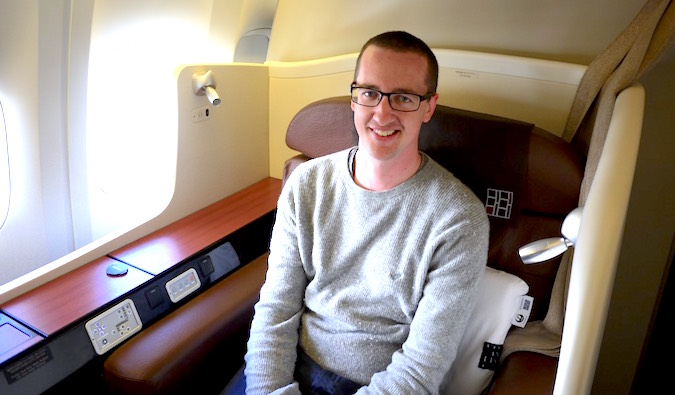
Keith from Point Hacks enjoying Japan Airlines First Class between Sydney and Tokyo
What’s the #1 way to earn points where you are?
Like many places, it’s mostly about frequent flyer or bank rewards program credit cards. The credit reporting system here is not as transparent as in the US, so I think people need to be more wary about hitting many sign-up bonuses and constantly switching cards — it can impact their ability to get other forms of credit in future, which could be more important, for example, a mortgage or car loan.
But that said, the banks put a lot of good offers out there to convince customers to switch, so there is a lot of appeal to use card bonuses and applications to boost balances as fast as possible.
My focus is to try and help people choose the right card or card rewards program that will work for their preferences in the long term — and if a sign-up bonus is good too, then that’s even better. That seems more sustainable for everyone.
Otherwise the mix of points-earning opportunities — outside of flying, of course — is pretty diverse, with utilities, supermarkets, mortgages, bank accounts, cinema tickets, online shopping, and most other product segments all having a points-earning option.
I’ve noticed a lot of credit cards in your part of the world come with very high fees. Is that a hindrance to collecting a lot of points? 
Generally the bonuses on offer are relative to the annual fee you’ll pay — though this is not always the case, as banks are trying to stimulate customers to switch a lot right now.
There are a handful with low fees ($0–100, say) that earn well, primarily American Express–issued cards. Otherwise, yes, you’re looking at fees north of $150 for the better points-earning cards, but if you’re a good customer, you can often get these annual fees waived or discounted.
It’s a small barrier to entry, but by no means a deal-breaker.
How can someone can get started? 
Funny you should ask! I created a free email course to help people earn more points and understand the system better. There are around 10 emails that will get sent out over three weeks.
In short though, I’ve met a few ex-pats who have ended up staying in Australia and want to get cracking on building up their balances here, and there are a couple of levels of things to consider.
Given we all know the need to try and consolidate your attention on a key program to earn a large, usable points balance, the first decision is around how “all-in” with Qantas Frequent Flyer you are. If your (or your partner’s) job has you flying with Qantas a lot, or for some other reason you want to be loyal to Qantas, then that’s pretty much your decision — Qantas has almost no credit card program transfer partners here, with Qantas-branded and “direct earn” cards making up the bulk of the market.
Qantas is not a bad program — it’s easy enough to rack up a large number of points from retail purchases and credit card spending to offset their high points-redemption rates (when compared to Asia Miles, for example) — and Qantas Points are one of the best-value ways of redeeming for travel with Emirates, who have a key route network to and from Europe and the Middle East from Australia.
If you can afford to look away from being totally loyal to Qantas, then it’s usually worth doing so. KrisFlyer, as we know, has some great value redemptions on Singapore Airlines–operated flights, and Singapore Airlines has a massive presence here, while Asia Miles can offer some great redemption pricing to Asia, the US, and Europe too.
And finally, Virgin Australia’s Velocity program is slightly better priced, with generally better redemption availability for Australian domestic flights.
So in all, if you are earning the majority of your points in Australia from credit card spending, going for a flexible points program is usually the right way to go to get the most value.
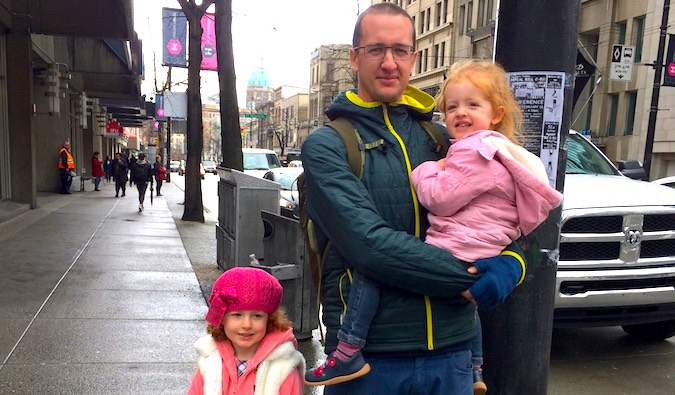
Keith hanging out with his family in New York City
Where do you see the future of travel hacking in your part of the world?
I hope we don’t move toward the US model! It seems US frequent flyer programs are forging a path toward revenue-based point-earning rates and redemption quickly, and we actually have it OK here by comparison if that fully materializes.
I also think that the relative simplicity in the Australian market is a good thing for consumers — there is some healthy tension and competition between Virgin and Qantas now — and this is relatively new, having grown over the last four years.
We aren’t at the point where we have a full roster of programs to choose from, so this actually makes life a lot easier in many ways: we have to look at how we maximize the opportunities from the programs we do have access to, instead of constantly hand-wringing about which program we should be using or splitting our hard-earned points across multiple programs.
For those earning from flying, it’s usually a choice between two carriers: Virgin or Qantas, which makes life pretty simple by comparison to many other markets.
As I mentioned before, both programs are very mature in their thinking and strategies in which they offer points earn opportunities, and the competition between them has generally kept redemption rates relatively steady. Qantas even reduced the cost of some economy redemptions earlier this year — I’m not sure I’ve seen that kind of move in many other markets.
So I feel like things are stable, and that’s a good thing.
When redeeming awards, how can consumers maximize their awards? Do you have three must-do tips? 
I’m going to focus on Qantas Points for these, given that’s the currency most people have ready access to here. (We just wrote up our best uses of 100,000 Qantas Points here.)
The first key idea is to get your head around who Qantas’s best partners are, versus their Oneworld partners, who are higher priced. American Airlines, Emirates, Jetstar, and Fiji Airways are the key redemption partners where you can redeem your miles at a cheaper rate (the same rate as redeeming for Qantas flights). Given how few frequent flyer partners Emirates has, using Qantas Points for Emirates flights ends up being a great use for them.
Qantas also has a very good multi-sector round-the-world award chart, too. This is a great redemption to aim for, which can be used for up to 35,000 miles of travel in economy, premium, business or first class, with stopovers in up to five cities over a 12-month period.
Pricing seems high at 280,000 points in business class and 420,000 in first class, plus $1,000–1,550 in fuel surcharges and taxes per person. But this is only a little higher than a return redemption to Europe or New York from Australia, so it’s an easy way to add on a heap of additional flights and destinations. This works for any class of travel too, not just premium cabins.
Finally, don’t forget about Jetstar redemptions as a good use of Qantas Points. They are priced even more cheaply than Qantas’s own flights, given that they are a low-cost carrier, and they operate a “premium” cabin, StarClass, which is priced similarly to premium economy levels, in terms of points, on many international routes. Jetstar has a massive route network across Southeast Asia, Australia, New Zealand, and Japan — and Qantas Points are one of the main ways to redeem for Jetstar flights, if cash prices for tickets are high.
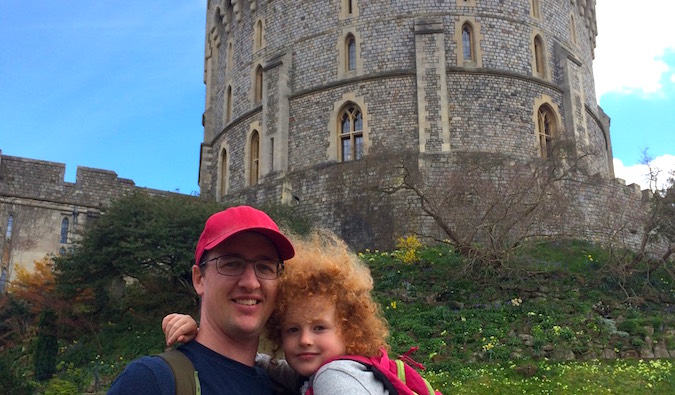
Keith being a tourist with his daughter at Windsor Castle
Here in the US (and in Canada) you can multiply your points earned and “juice” your account via dining programs, gift cards, shopping online, and a ton of other bonuses. Do you have similar programs? 
We sure do. I’d say we have as many as any other region. Qantas and Virgin’s Velocity program both offer the ability to earn points from dining, movieswine, gift card purchases, and utility and phone bills — there’s probably a points-earn partner in almost every product category.
One of my favorite ways to pick up more points from everyday spending is by having the right credit card with bonus point categories to meet your spending habits. These are primarily American Express–issued cards, but Citi has an option too in the Citi Prestige Visa (which is a bit different here than the Prestige issued in the US).
We’ve run through some of the credit cards with bonus points for travel, bonus points for supermarket spending, bonus points for gas/fuel, bonus points for restaurants and cafés, and finally, one of my favorites, bonus points for overseas spending.

Sunday, 7 May 2017

HOW TO VISIT MALTA ON A BUDGET


beautiful harbor in malta
For centuries, the Maltese archipelago passed between North African Moors and European Crusaders in an epic struggle for control of this important hub. This constant back-and-forth created a unique culture that blended architectural, culinary, and cultural styles (in fact, the Maltese language is a mix of Arabic and Italian) found nowhere but maybe Southern Spain.
Now, the country draws people less with the whole conquering-empires thing and more with its warm summer temperatures, pristine beaches, clear Mediterranean water, ample hiking, friendly locals, and cheap prices.
Though I didn’t spend as much time as I wanted in Malta, I spent enough (literally and figuratively) to get a sense of how to travel the country on a budget. Luckily, the country is already very budget friendly (it’s one of the cheapest Eurozone countries out there) so you don’t need a lot to begin with. Even though I was on a holiday and not being as budget friendly as I wanted, I still never spent a lot of money. My most expensive day cost me 70 EUR ($74), and that’s because I rented a car! Even when I was watching my wallet, at no point did I ever feel as if I was missing out.
Though Malta will never break your budget, I always am one to look for a deal, as I’m a firm believer that every destination has a way to be cheaper.
So here is your in-depth guide to visiting Malta on a budget:

Getting There

While most European carriers operate seasonal flights, there aren’t many airlines that fly to Malta year-round. Ryanair, Air Malta, easyJet, and Lufthansa are the biggest carriers that service the island year-round. One-way flights from the mainland cost 50-100 EUR ($53-106 USD), especially if you book in advance. You can also take the ferry to/from Sicily; it’s 2.5 hours and costs 61-127 EUR ($65-135 USD) each way (depending on the season).

Typical Costs

cars on a colorful street in malta, photo by Tobias Scheck (flickr: @uncloned)
Malta is cheap. While I went in the middle of winter — without the seasonal increase in prices for accommodation, car rentals, and flights — many friends told me that most prices for food, activities, and public transportation stay the same throughout the year. Here is a list of typical costs in the country:
  • Ferry to Valletta from Sliema: Single: 1.50 EUR ($1.60 USD), Return: 2.80 EUR ($2.95 USD)
  • Ferry from Malta to Gozo: Pedestrian: 4.65 EUR ($5 USD), Car and Driver: 15 EUR ($16 USD)
  • Pastizzi (cheap snack): 1-2 EUR ($1-2.10 USD)
  • Breakfast sandwich: 3-4 EUR ($3.15-4.25 USD)
  • Full breakfast: 8-9 EUR ($8.50-9.50 USD)
  • Lunch at a café: 8-10 EUR ($8.50-10.50 USD)
  • McDonald’s value meal: 5-6 EUR ($5.25-6.50 USD)
  • Sandwich: 6 EUR ($6.50 USD)
  • Nice dinner at a sit-down restaurant with wine: 25 EUR ($27 USD)
  • Main meals: 10-14 EUR ($11-15 USD)
  • Pizza: 6-9 EUR ($6.50-9.50 USD)
  • Bottle of water: 1 EUR ($1 USD)
  • Bottle of wine: 8-10 EUR ($8.50-10.50 USD)
  • Beer: 3 EUR ($3.15 USD)
  • Museum entrance: 6 EUR ($6.50 USD)
  • Car rental: 38-48 EUR ($40-50 USD)
  • Taxi prices: 10-20 EUR ($10.50-21 USD)
  • Public bus ticket: 2 EUR ($2.10 USD)
On average, you’ll be able to visit Malta for 30-45 EUR ($32-48 USD) per day, though in the summer I would say you need to budget closer to 50 EUR ($53 USD). At that price, you’re looking at staying in a hostel dorm or splitting an Airbnb with a friend, taking public transportation, mostly sticking to the free activities, cooking your breakfast, and eating at the cheap(er) cafés.

How to Save Money in Malta

Accommodation
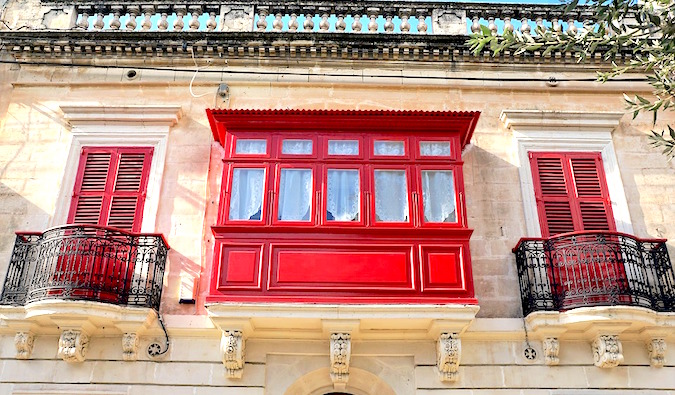
beautiful building facade and bright red shutters in malta
There are a couple of hostels on the islands, with dorm prices beginning at 9 EUR ($9.50 USD) per night (though prices double in the peak summer time). Airbnb is ridiculously cheap — I found a whole house for 35 EUR ($37 USD) a night. Most budget hotels cost 40 EUR ($42.50 USD) so I would stick to Airbnb or hostels for accommodation. However, like hostels, the prices for places more than double to around 80 EUR ($84 USD) per night in the summer; budget hotels cost around 40-60 EUR ($42-63 USD) in the summer.
To save money on accommodation, travel off-season and stay in dorms or split Airbnb units with friends. You can use the website eurocheapo.com to find good B&Bs, as they have a robust listing.
Food and Drink
good mediterranean food in Malta, photo by: (flickr: @)
Food prices are relatively inexpensive, though you’ll find higher prices in tourist areas such as Valletta, St. Julian’s, Sliema’s boardwalk, and Marsaxlokk.
To save money on food, stick to the pastizzi (savory filled pastries) for about 1-2 EUR ($1-2.10 USD), eat at the plethora of vegan and vegetarian restaurants throughout the country (see the list below), avoid snacking, and cook as many meals as possible (breakfast will see the biggest wins).
Transportation
ferry from valletta to sliema in malta, photo by Charlie Dave (flickr: @charliedave)
There are three ways to get around the island: buses, taxis, and car rentals. Buses cost 1.50-2 EUR ($1.60-2.10 USD) for a two-hour ticket or 21 EUR ($22 USD) for a weekly pass, while car rentals cost 39 EUR ($41 USD) per day (in the summer they start closer to 50 EUR or $53 USD per day). There are a number of local rental companies, but I used Hertz since it was close to my Airbnb. Many of the local car companies don’t take credit cards and want deposits in cash. Going with bigger companies adds another layer of security.
Taxis cost 10-20 EUR ($11-21 USD); while not ideal, they can be ordered ahead of time via Whatsapp and are a good last-minute option if you get stuck because the bus doesn’t turn up.
One thing to note about the buses is that they are infrequent so they fill up fast. We got on one bus, only to have him pull over, kick everyone off, and put us all in another bus, that then waited for 20 minutes to move. It’s a crazy system and, during the summer months when the crowds peak, expect long waits. Don’t be in a rush if you’re using the bus!
Activities
azure window at a beach in malta, photo by Berit Watkin (flickr: @ben124)
When the weather is nice, there are a bunch of free activities to do, such as enjoying the beach, hiking, swimming, and just walking around. Additionally, all the churches are free. You’ll find a lot of companies that will take you around the island in a boat for 25 EUR ($27 USD). Most museums and attractions cost 5 EUR ($5.25 USD) but you can get a Malta tourism card (there’s one for Mdina and a separate one for Valletta) that will save you about 10-20 EUR ($10.50-21 USD) depending on how many attractions you squeeze in.
On a side note, I found the main tourism center in Valletta unhelpful. The staff couldn’t answer a lot of my questions. The smaller, unofficial locations that littered Sliema’s boardwalk had more information on car rentals, things to do, and prices.

Recommended Bars and Restaurants

Restaurants: Rising Sun (Mdina), Loli (vegetarian), The Grassy Hopper (vegan/vegetarian), the Marsaxlokk fish market, Suruchi, Ta Doni, Cuba, Rocksalt, Ta’ Rikardu (Gozo), Electro Lobster Project.
Bars: Hole in the Wall (Sliema), Native (and any bar on that street as it’s the main hub for nightlife), Dubliner, Legligin, The Thirsty Barber
****
It’s easy to visit Malta on a budget. I was shocked at how cheap this place. Even with summertime increases in accommodation and tour prices, Malta remains an affordable country. I’ve been to all the Eurozone countries now and I have to say Malta is one of the best — if not the best — value. When you combine it with warm weather, amazing landscape, historic cities, and incredible beaches, Malta because one of the best destinations to visit in Europe if you’re looking to save money.
Looks like all those British retirees were on to something after all!

THE BEST WAY TO TRAVEL AROUND SOUTHERN AFRICA


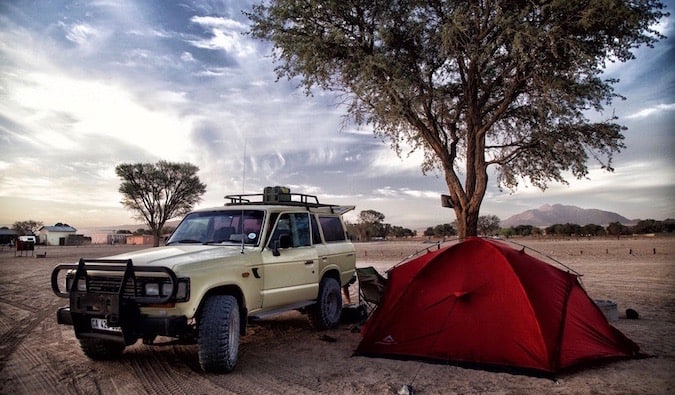
camping in southern Africa
Welcome to another edition of our new Africa column with Natasha and Cameron from The World Pursuit. While I’ve been to the continent in the past, I’ve only seen a few countries and this website is really thin on Africa content. I’m super duper excited to have these two travelers share their knowledge about traveling the continent. They will share budget tips, detailed guides, itineraries, and stories to get you excited and prepared for your own trip! Their second post is on how to get around Southern Africa with different budget travel options.
Ten months ago we started thinking about our trip through southern Africa. We knew that the region was vast and that travel there was a difficult mystery. We weren’t even sure if it was possible to cross the continent on our own. All we knew was that we wanted to see the great African plains, watch lions attack impalas, and have a drink while listening to the sound of fish eagles.
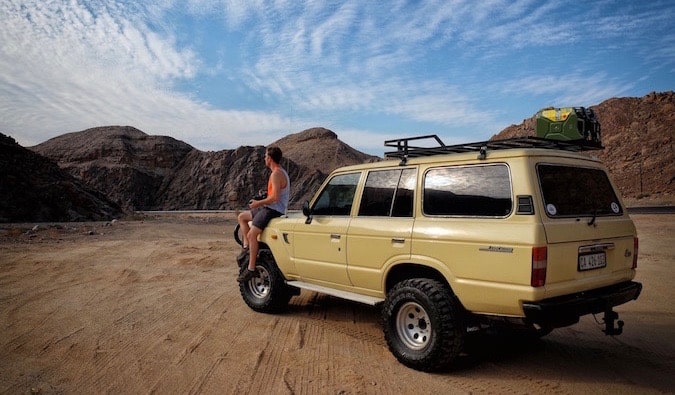
Fast forward nine months, and we now own a South African–registered Land Cruiser and have been touring the massive continent by ourselves. How did we get to this point? Was it the cheapest option? Or did we make a massive blunder by throwing a bunch of cash into a major liability, what with bad roads, border officials, bribes, and mechanical costs? Perhaps an overland tour would have been the best option? Or might backpacking across the continent have achieved our goal?
What is the best option for budget travelers in southern Africa: an overland tour, backpacking, or self-driving? It all comes down to what you want to see and how you want to experience Africa. Here are the pros and cons of each option:

Overland Tours

Overland tours are one of the most popular options for young people wanting to travel southern Africa these days. All transportation and accommodation, most food, and many activities are covered. They require little to no planning and no driving, are safe, and offer a sure way to meet other travelers.
Acacia Africa, Nomad, Oasis, and Absolute Africa are four of the most popular “budget” overland safari companies. These tours venture in and around South Africa, Namibia, Botswana, Zimbabwe, Zambia, and Malawi (as well as Rwanda, Uganda, Kenya, and Tanzania). Some tours cut out a few countries, while the “mega” tours include all of them. Some of the tours spend only two days in a certain country; others may spend a week there.
Acacia and Nomad include almost all activities, food, and park fees in the cost. They save the additional expenses for specialty experiences, like bungee jumping off the Victoria Falls Bridge or a hot-air balloon ride over the Serengeti.
Oasis and Absolute, on the other hand, opt for a pick-and-choose model and include only a limited number of activities. Instead, they drive you from point A to point B and allow you to book experiences with local operators. Oasis and Absolute also include only 60% of your meals. (If you want all of the adventure activities included, the four providers are similar in price.)
Regardless of the overland company, expect to add roughly $5-10 USD a day for various expenses, like waters, beer, and tipping your guides.
Tour CompanyAverage Daily Cost
Acacia$101.80 USD
Nomad$100.00 USD
Oasis$55.82 USD
Absolute$64.46 USD
Note: The prices differ according to where in Africa you are traveling, albeit not drastically. This is a crucial detail when determining to take an overland tour or go at it alone. Southern Africa is intrinsically cheaper and easier to do on your own than the rest of Africa. I like to call it “Africa Light.” Gas is cheaper, national parks are cheaper, food is cheaper, and the infrastructure is better suited for tourism. A tour in South Africa may average $86 USD a day with Acacia, while its East Africa tour will average $121 USD a day.
Pros of doing an overland tour in southern Africa:
  • Organized tour that requires little to no planning on a challenging continent
  • Great option for meeting people, especially as a solo traveler
  • Knowledgeable guides and safe drivers on harsh road conditions
  • Groups can be great fun
Cons of doing an overland tour in southern Africa:
  • Lack of “adventure” on an organized tour
  • No independence and hard to get away from the typical tourist activities
  • Lack of genuine local interaction
  • High cost
  • Enjoyment is subject to the atmosphere of the group
Note: There are a few experiences offered by some overland tours that we do not agree with ethically. Any tour that puts you in contact with wild animals, such as lion walks, cheetah petting, and elephant riding, should raise immediate red flags. Ethics and tourism in Africa can be very murky; don’t always expect your tour operator to vet every activity and attraction.

Self-Driving

road trip in southern Africa
There are a plethora of variables that go into self-driving, but we’ll stick with the basics. Operating on the assumption that you will not choose to purchase a vehicle in Africa (you’d have to be crazy like us), your four main expenses will be transportation, food, accommodation, and activities.
Transportation
When we first arrived in South Africa, we got a small pickup rental truck for $650 USD a month ($21 USD a day), split between the two of us. We went with a 2×4 to travel through Mozambique, but if you route carefully and skip the dirt roads and sand, it’s very possible to get around most of southern Africa in a sedan (we’ve even met people doing it on motorcycles)!
Rental vehicles are the cheapest in South Africa and can be driven into neighboring countries with a letter from the rental company stating your intent to cross borders. A manual sedan in Johannesburg can be rented for as little as $120 USD a week.
You may want to drive to remote areas, which means a fully kitted 4×4 rental; those come in at $800 USD a week out of South Africa and Namibia on the low end for a round-trip car rental.
However, for that price, you can score a truck that can go anywhere and has comfortable roof tents that can accommodate four people — which is the best way to get one heck of a safari for an affordable price. (We self-drove into the Okavango Delta and got further than any backpacker or overland tour could ever go.)
It’s important to factor in road tolls and gas into your costs. Tolls in southern Africa are few and far between, but they do exist and you can expect to pay $10–20 USD a week in tolls if you’re driving around South Africa.
Keep in mind that distances are vast in Africa, so you’ll be covering some major ground getting from point to point. Southern Africa is bigger than all of Europe, so expect to budget about $100–200 USD a week for fuel, depending on how fast you move and the distances covered.
While these numbers may be difficult for a solo traveler, a group of friends together can make an African road trip very cheap. Obviously, the cost per person goes down with the more travel companions you add; $10 USD a day for gas and the rental is possible per person in southern Africa if split four ways. With two people in a smaller car, it’s entirely possible to drive around for $15 USD a day per person. If you don’t have travel partners, try joining groups on Facebook like “Backpacking Africa” or posting in Lonely Planet’s Thorn Tree forum.
Food
Food in Africa can be very affordable (of course there are some exceptions to this if you are eating out or have a special diet). You can find almost everything you want at large Western supermarkets in South Africa; however, as you work your way north, Western-style grocery stores become a rarity. Outside of big cities, most food will come from roadside stands or tiny convenience stores — all of which offer affordable local prices. If you’re cooking your own meals, you can get by on less than $70 USD a week for food. That includes eating three meals a day and items that may be considered luxuries to backpackers, such as steak, real coffee with milk, and a decent sandwich lunch.
Accommodation
Campsites can range from $5–15 USD per person a campsite; this does not include a tent or sleeping bag. Camping in southern African national parks is closer to $20–30 USD per person plus daily park fees. The campsites, except in Botswana, are usually fenced in to provide protection from wildlife and have facilities such as an ablution block. In major cities, you will be able to find hostels, budget hotels, and Airbnb rooms, and it’s possible to get a bed for the same price as camping. Dorm beds run $10–20 a night and a double room $25–50 USD a night. But this isn’t Europe, so don’t be picky, and prepare for some less-than-desirable rooms. If you’re feeling truly adventurous, rooms in local roadside establishments cost around $3–8 USD a night but don’t plan on sleeping much because they’re often noisy and a little dirty.
Activities
You can’t get around Africa without some activity expenses. However, if you have plans on seeing any wildlife, you will have to pay—national parks, private game reserves, and safaris all cost money. The good news is that park costs in South Africa, Namibia, Botswana, and Zimbabwe are all reasonable, considering that these are some of the best game parks in all of Africa. Although you won’t have the comfort of being in a big game viewer and will have to spend money on fuel driving around the park all day, you will still able to see wildlife driving your own vehicle on your own time.These are some average national park fees in southern Africa:
Namibia$9 USD
Botswana$12 USD
South Africa$15 USD
Zambia$25 USD
Zimbabwe$30 USD
Note: These fees are based on international passports and do not include vehicle fees. Note that almost every park in Africa charges a vehicle fee for self-drivers. The fee can range anywhere between $5 USD and $50 USD a day, depending on the country and the car’s type and registrationIn summary, it is next to impossible to estimate a budget for driving yourself. Here are some average self-driving costs per day per person:
Rental car and fuel (two persons)*$15 USD (sedan) to $57 USD (4×4)
Accommodation$10 USD (camping) to $25 USD (dorm or shared private room)
Food$10–15 USD
Activities$10 USD
Total$45–105 USD
* Prices are based on weekly car rentals starting in South Africa, where rentals are cheapest.
Pros of self-driving southern Africa:
  • Sense of adventure tackling southern Africa on your own
  • Freedom to drive wherever you want
  • National parks are cheaper than hopping on an organized safari
  • You can take as much or as little time in a place
  • You can delve deeper into local and rural African life with your own set of wheels
Cons of self-driving southern Africa:
  • The paperwork and bureaucratic headache of crossing borders with a car
  • Constant planning and routing and always being “on” can become exhausting
  • Maintaining and fixing the car if anything goes wrong
  • Little to no help if problems arise
  • Poor road maintenance can lead to potholes and road corrugation

Public Transport or “Backpacking”

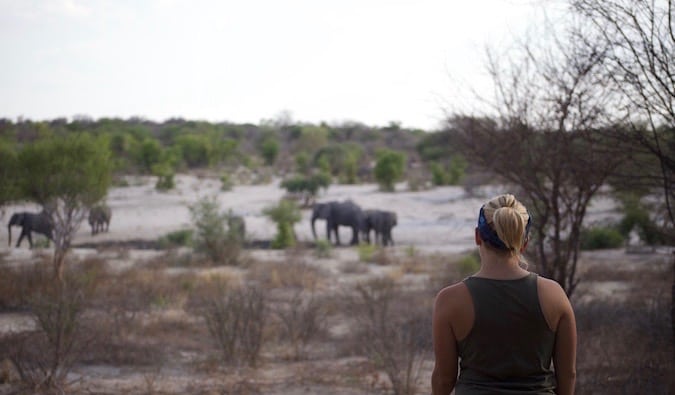
safari in southern Africa
It is incredibly hard to estimate the cost of backpacking around southern Africa because it can vary so widely depending on one’s style. It’s also dependent on if you want to completely go off the grid or if you want to do touristy things. Some may be okay with walking into a village, paying a few dollars to the local chief, and pitching a tent in the dirt, while others wouldn’t dream of this and would rather take public transport from campsite to campsite. Living like a local in southern Africa is very hard if you’re traveling. Poverty is rampant in Africa, and many Africans can’t even afford to adequately feed themselves, let alone travel to the next town while living on a dollar a day. Due to the lack of demand and infrastructure for long-distance travel, the transport options are much more difficult compared to the West and Asia.
Transportation
Local buses around town can cost anywhere from $0.25 USD to a $1.50 USD. They also only serve local towns and villages. For the larger intercity buses, you can expect to pay $8–25 USD for a 4–12-hour bus ride (sometimes longer). Tourist spots, parks, hostels, and campsites are often not near any major towns or villages, so you’ll need some budget for local taxis or plan on hitchhiking. The price of a taxi can range from $3–15 USD, depending on distance and remoteness.
Food
There shouldn’t be any difference here compared to self-driving. The only exception is that self-drivers have the advantage of buying items in bulk and carrying cooking gear with them. If you are traveling by local transport and backpacking, your food options may be cheaper as you eat more and more of the local food and have less access to supermarkets. On the other hand, your costs could rise since you may not have the proper gear to cook all your own meals and may, therefore, frequent restaurants more.
Accommodation
Campsites, hostels, and guesthouses will not differ in pricing compared to those for self-drivers. However, as an overland traveler without a car and just a backpack, you can sometimes instead pay a small fee ($3–5 USD) to a local village chief and pitch a tent in the community.
Activities
While you’ll be able to save on most things when backpacking southern Africa, you will lose out when it comes to seeing wildlife. Whereas overland tours and self-drivers have their own vehicle, backpackers will have to pay for each and every safari experience they want to have. Hopping on a day game drives into game parks costs $40 USD on the cheap end and $200 USD on the high end. The price difference is large, but most backpackers may visit fewer parks, so the cost difference isn’t out of this world. These are some average backpacking costs per day:
Transportation$9 USD
Accommodation$10 USD
Food$10 USD
Activities$15 USD
Total$44 USD
It is possible to backpack Africa for cheaper; we’ve even met people walking, backpacking, or cycling around the continent. However, someone who travels slowly, camps in villages, and skips national parks will have a much different trip than overland tours and self-drivers in southern Africa.
Pros of backpacking southern Africa:
  • Complete integration into local life
  • Cheaper than a tour or self-driving
  • Breaks boundaries with locals as they do not view you as having many means
  • Operate on your own schedule
Cons of backpacking southern Africa:
  • Uncomfortable, exhausting, long, and even dangerous bus and train rides across the continent
  • Greater chance of getting in an accident or having items stolen
  • You should get used to being dirty
  • No one to help you should something go wrong
  • Constant routing and planning can get tiring

Final Verdict

exploring southern Africa
So what’s the best option for seeing southern Africa? It’s a difficult decision because overland tours are certainly the easiest, but also the most expensive and least adventurous. Backpacking can be difficult and uncomfortable and may hinder your experiences in Africa as most of the natural sights and national parks are far removed from populated cities where public transport operates. However, if you’re looking to meet some of the friendliest people on earth Africans are quick to befriend a backpacker. Self-driving falls somewhere in the middle, as it can be incredibly adventurous but will offer the most flexibility with a more mid-range price tag.
In my opinion, southern Africa is best done on your own because of its infrastructure and lower cost. Travel through each country varies a lot. In the end, it comes down to what you are looking for in terms of adventure, interactions, costs, comfort, and ease.
Natasha and Cameron run the blog The World Pursuit, focusing on adventure and cultural travel. The two of them met in the film industry before they decided to abandon the American lifestyle and travel the world together. They’ve been traveling together for three years across 55 countries and six continents.  They recently bought a 4×4 at the tip of Africa and are traversing the continent while documenting their story on Instagram and Facebook